

Airflow Analysis
Understand airflow direction, velocity distribution and circulation.
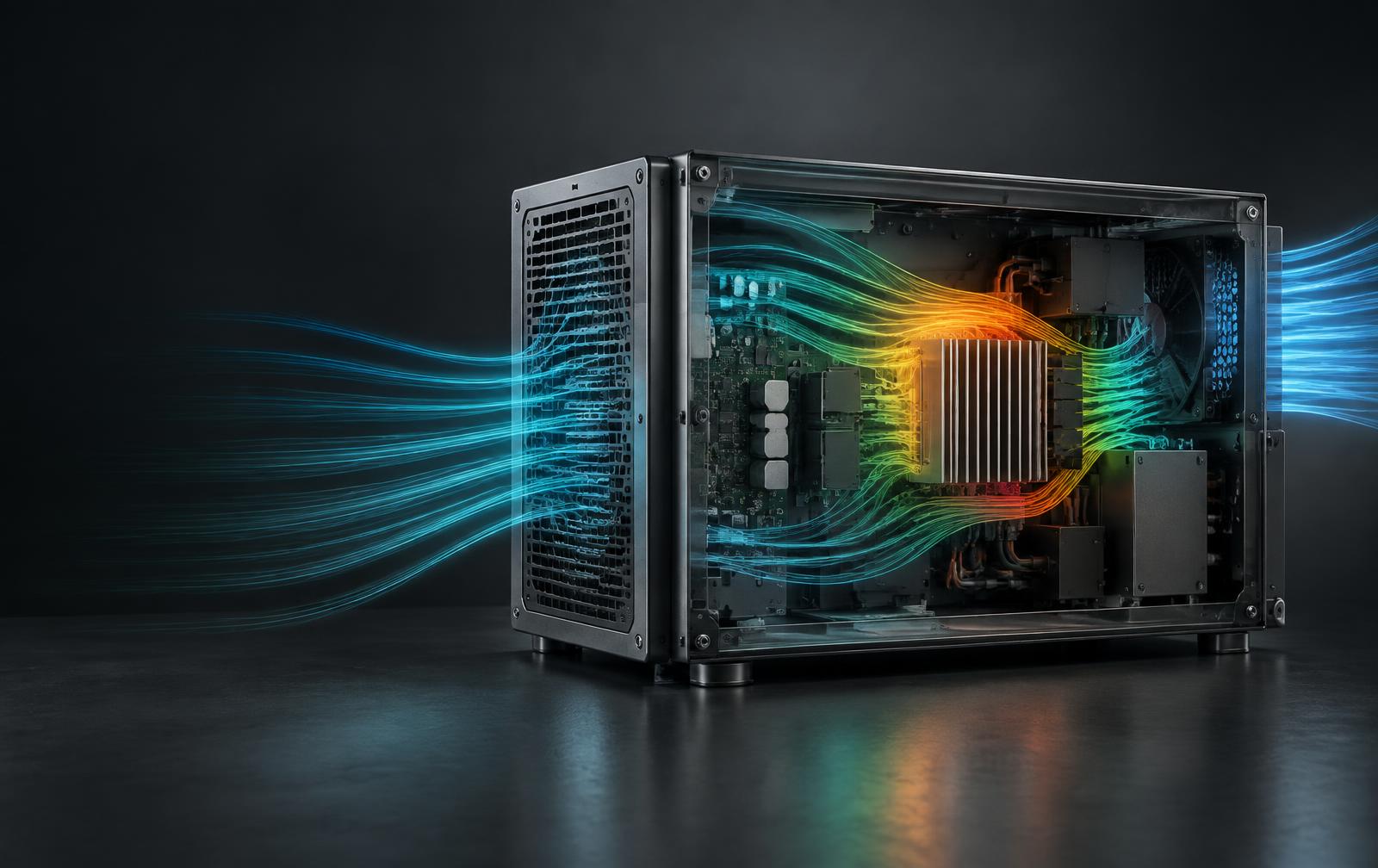
Engineering Services / 02
Understand airflow, heat transfer, pressure and fluid behaviour before building the physical system.
Overview
Computational Fluid Dynamics (CFD) uses a numerical model to investigate how fluids move and transfer heat. Nutechra provides flow simulation, airflow analysis and thermal analysis for products and engineering systems, using SOLIDWORKS Flow Simulation for suitable projects. The focus is on understanding flow paths, pressure losses and temperature behaviour to inform practical design decisions.
Depending on the project, useful inputs include geometry, material properties, heat loads, ambient conditions, fan curves or other flow data, and the operating scenarios to assess. Clear objectives—such as investigating an enclosure hot spot or comparing ventilation arrangements—help define a useful study.
Typical questions include how air moves through an electrical enclosure, whether equipment cooling reaches heat-generating components, and how an industrial airflow path affects pressure loss. Results depend on boundary conditions, heat inputs and modelling assumptions. Mesh resolution, energy and flow balance, and comparison with available measurements are relevant result checks; the checks appropriate to a project should be agreed within its scope.
Capability
Understand airflow direction, velocity distribution and circulation.
Evaluate pressure distribution and pressure drop through systems.
Study temperatures, heat transfer and cooling performance.
Evaluate airflow performance within enclosures, equipment and occupied spaces.
Improve cooling effectiveness for equipment and electronic systems.
Evaluate the behaviour of liquids and gases through engineered systems.
Compare design alternatives and identify improvements before fabrication.
Value
Use cases
Project outputs
Velocity, pressure and temperature plots, together with flow trajectories, can show restricted flow paths, recirculation or potential hot spots. An agreed summary can explain assumptions and limitations and compare design options. Predicted performance is not a guarantee of the physical system’s performance under all conditions.
Start with the challenge
Tell us what you are trying to solve. Nutechra will review the challenge and help identify the right engineering approach.